
From deployed technology to structural insight
Results update — September 2026. Verdant’s Gen5 turbine development combines operating experience with laboratory testing to improve future tidal energy systems. The Gen5d blade design was deployed at the Roosevelt Island Tidal Energy Project in New York’s East River before a separate TEAMER-supported campaign tested a full-scale blade to ultimate structural failure.
The Gen5d composite blade
Manufactured by Composite Builders in Holland, Michigan, the tested blade was 2.5 meters long and made from prepreg fiberglass and epoxy resin using vacuum bagging and an autoclave process. Two bonded skins and an expanding epoxy-foam core formed the blade. Earlier static and fatigue testing provided a foundation for the destructive campaign.
Preparing the load-to-failure test
Verdant supplied FAST Version 8 load cases for normal generation, a brake event and freewheel overspeed. The brake-event case, LC2, served as the baseline. The more severe LC9 overspeed case assumed an infinitely stiff blade, an assumption the results suggest should be revisited with realistic blade flexibility.
Applying and measuring the loads
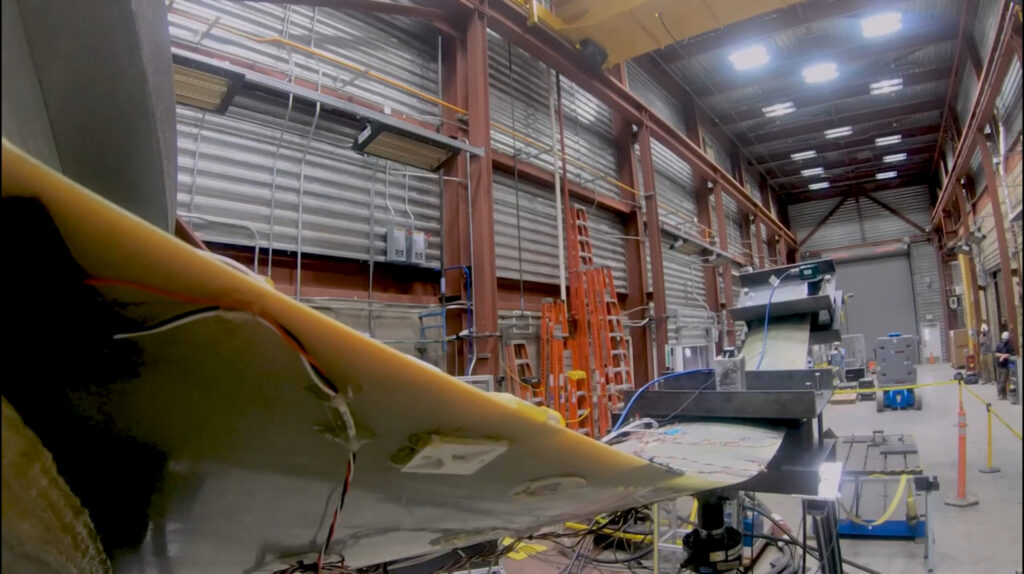
The National Laboratory of the Rockies developed a dual-actuator configuration, applying loads approximately 1.2 and 1.97 meters from the hub edge to better reproduce the modeled bending-moment distribution. Calibrated load cells, displacement sensors, inclinometers, optical tracking and strain gauges measured the blade’s response as loading increased.
Measuring large blade deflections
At the highest loads, the blade tip rotated approximately 60 degrees. The team used measured blade deformation and actuator and saddle angles to calculate bending moments and shear forces. Accounting for these changes was important to understanding the actual load distribution at failure.
What the blade test demonstrated
The blade completed a load block at 225% of the LC2 baseline load. The first attempt at that level produced an acoustic event and reduced stiffness; a repeat showed 10–12% greater displacement at equivalent loads. The blade subsequently failed in shear during the final load block, before that block’s planned target moment was reached.
Turning test data into better designs
The reported root bending-moment overload factor was 2.78 relative to LC2 for this test setup. The fixture differed from the deployed hub, so this is not a universal operating safety factor. Large blade deflections also affected the calculated loads. The findings support more realistic elastic-blade models and future designs that reduce unnecessary conservatism while maintaining structural performance.